In this guide (12 sections)
- Our top picks
- Ball Head vs Pan Tilt Head for Landscape Photography: The Short Answer
- Quick Comparison of Our 5 Picks
- The 3 Ball Heads and 2 Pan-Tilt Heads We Recommend
- How a Ball Head Works and Its Disadvantages
- How a Pan Tilt Head Works and Where It Falls Short
- Ball Head vs Pan Tilt Head for Landscape Photography, Side by Side
- Which Tripod Head Type Is Best for Your Landscape Tripod?
- Buying Guide: What to Check Before You Buy a Landscape Head
- Can You Use a Ball Head for Video?
- Final Verdict: Ball Head vs Pan Tilt Head for Landscape Photography
- Questions photographers ask
We earn a commission if you buy through links on this page, at no extra cost to you. It never changes what we recommend. How we make money.
How we picked these
- 19 owner posts, user discussions and expert reviews read across 12 sources.
- Every spec checked against 5 maker and retailer pages.
- We did not test these products ourselves, and we say so. All sources are linked at the end of this guide.
Our top picks
 Best budget ball head · 3.5/5Manfrotto 496RC2 Compact Ball Head
 Best value landscape ball head · 4.1/5Leofoto LH-40
 Best lightweight pick · 4.1/5Sirui K-30X Ball Head
 Best 3-way pan-tilt head · 3.4/5Manfrotto XPRO 3-Way Head MHXPRO-3W
 Best geared head for precision · 3.5/5Benro GD3WH 3-Way Geared Head
The short answer
- A ball head is faster, lighter and better for hiking; a pan tilt or geared head is slower but levels horizons and frames panoramas with more precision.
- Pick a ball head if you chase changing light and carry your kit far; pick a pan tilt or geared head if you shoot slow, deliberate compositions.
- The Leofoto LH-40 and Sirui K-30X give the most Arca-Swiss ball head for the weight; the Benro GD3WH is the geared pick for exact framing.
- Arca-Swiss compatibility matters more than head type for long-term flexibility: two of our five picks use Manfrotto's proprietary 200PL-14 plate.
Ball head vs pan tilt head for landscape photography is a choice that comes down to one trade: speed and weight against precision. A ball head lets you swing the camera anywhere with a single knob, while a pan tilt head (also called a 3-way head) moves one axis at a time so the horizon stays put. I’ve seen photographers argue both sides for years, and in my view neither answer is wrong. It depends on how far you walk, how fast the light moves and how fussy you are about a level horizon. Below I give you a short answer, five heads worth considering, and a clear way to decide.
Ball Head vs Pan Tilt Head for Landscape Photography: The Short Answer
Choose a ball head if you hike, travel light and need to reframe fast; choose a pan tilt or geared head if you shoot slow, deliberate compositions where a perfectly level horizon matters. Most landscape photographers I talk to end up on a ball head because it is lighter and quicker, then add a panning clamp or leveling base when they start shooting panoramas.

Here is the decision in one place:
- Choose a ball head if you carry your tripod on long hikes, chase fast-changing sunrise light, shoot in cold weather with gloves on, or want the smallest packed size.
- Choose a pan tilt head if you want separate pan, tilt and portrait controls, shoot architecture-style landscapes, or keep knocking the horizon off level.
- Choose a geared head if you shoot stitched panoramas, focus stacks or graduated ND filter work where millimeter framing matters, and you mostly shoot near the car.
Quick Comparison of Our 5 Picks
Three of these picks are ball heads and two are pan-tilt style heads, and the biggest practical differences are weight, rated load and plate system. All figures come from manufacturer specs and retailer listings, so treat them as the maker’s claims rather than measured values.
The table below compares head type, load, weight, plate system and the shooter each head suits best.
| Head | Type | Max load (maker) | Weight | Plate system | Best for |
|---|---|---|---|---|---|
| Manfrotto 496RC2 Compact Ball Head | Ball head | about 6 kg (listings conflict) | Light (not listed) | Manfrotto 200PL-14 | Budget hiking kit |
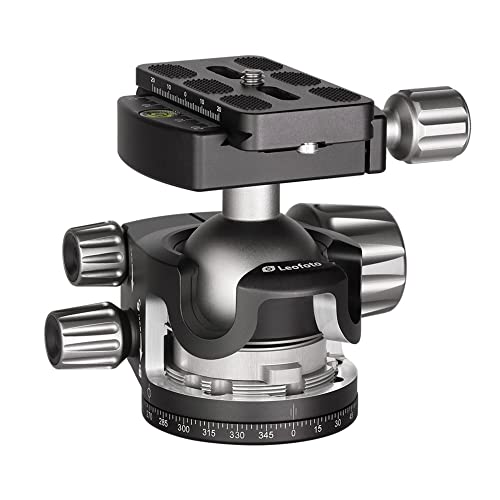
| Leofoto LH-40 | Ball head, 40 mm ball | 20 kg | about 490-540 g | Arca-Swiss compatible | Best all-round value |
| Sirui K-30X Ball Head | Ball head, 44 mm ball | 30 kg | about 0.5 kg | Arca-style | Light travel kit |
| Manfrotto XPRO 3-Way Head MHXPRO-3W | 3-way pan tilt | 8 kg or 12 kg safety payload (sources conflict) | about 1 kg | Manfrotto 200PL-14 | One axis at a time |
| Benro GD3WH 3-Way Geared Head | 3-way geared | 6 kg | about 0.75-0.87 kg (listings differ) | Arca-Swiss compatible | Exact framing |
The 3 Ball Heads and 2 Pan-Tilt Heads We Recommend
The Leofoto LH-40 is the ball head I would point most landscape shooters to first, while the Benro GD3WH is the pick if precision beats speed for you. Each head below gets its strengths and its drawbacks in plain terms. We score them with the five criteria on our how we score page, leaving height out because a head doesn’t set working height.
Manfrotto 496RC2 Compact Ball Head: Best budget ball head
3.5Best Tripod Score out of 5
- Stability6/10
- Portability (weight and folded length)9/10
- Build (materials, leg locks, head)6/10
- Value8/10
Light and compact; proprietary plate and modest load rating.
What owners and reviewers say from 4 reviews and posts we read
Praised for
- Smooth movement and firm lock with mid-weight DSLR and 70-200mm f/2.8 setups
- Light and compact, works well on a monopod
Common complaints
- Proprietary RC2 plate will not take Arca-Swiss plates
- No bubble level on the head
Read on: Pentax Forums: Manfrotto mini ball head 496RC2 · Greentoe: Manfrotto 496RC2 listing reviews · Adorama: Manfrotto 496RC2
Who it's for: Landscape shooters with a mirrorless or DSLR and a mid-size zoom who want a small, light head and can use Manfrotto's own plate.
The Manfrotto 496RC2 Compact Ball Head is a small, light ball head that suits a hiking kit where every gram counts. Retailer listings disagree on its load rating: older listings say 6 kg, while listings for newer or differently configured versions give higher figures, so check the exact version before you rely on a number. It has a tension control and a 360-degree panning base. That panning base matters for landscapes: you can level the ball once and then pan across a scene for a panorama without loosening the ball itself. The main drawback is the plate. It uses Manfrotto’s 200PL-14 rather than Arca-Swiss, so an L-bracket or a plate from another brand won’t fit its clamp. The small ball also leaves less holding margin with a heavy full-frame body and a 70-200mm f/2.8, which is where ball heads start to creep after you lock them. If your kit is light and you already own Manfrotto plates, it is a sensible, compact starting point.
Leofoto LH-40: Best value landscape ball head
4.1Best Tripod Score out of 5
- Stability8/10
- Portability (weight and folded length)8/10
- Build (materials, leg locks, head)8/10
- Value9/10
High rating for its weight with an Arca-style clamp.
What owners and reviewers say from 1 review and posts we read
Praised for
- Controls described as smooth and easy to operate
- Low-profile design with separate pan lock and friction control
Common complaints
- No recurring complaint in the 1 owner post we read
Read on: Leofoto LH-40 at Adorama
Who it's for: Landscape photographers who want Arca-Swiss compatibility and strong holding power without premium-brand prices.
The Leofoto LH-40 is the ball head that makes the strongest case for this head type in landscape work. Its 40 mm ball is rated for 20 kg, and it weighs roughly 490-540 g depending on the listing, so the rated load sits far above a typical mirrorless or DSLR landscape kit. More margin between rated load and real gear generally means less droop when you lock off a carefully set composition. The Arca-Swiss style clamp is the other big plus: it accepts common Arca plates and L-brackets, which makes portrait-orientation shots much easier and keeps the camera centered over the tripod. The catch is the naming. Leofoto sells several variants, including the LH-40, LH-40PR and LH-40LR, and the clamp options differ between them, so match the exact model before you buy. I’d check whether you want a screw-knob or lever clamp, because that choice affects how quickly you can swap bodies in the field.
Sirui K-30X Ball Head: Best lightweight pick
4.1Best Tripod Score out of 5
- Stability8/10
- Portability (weight and folded length)9/10
- Build (materials, leg locks, head)8/10
- Value8/10
Strong rating for its weight.
What owners and reviewers say from 6 reviews and posts we read
Praised for
- Solid, smooth ball movement with wide friction range
- Holds camera and lens firmly, feels well made
Common complaints
- Traditional screw-type friction control is the biggest drawback
Read on: LensVid: Sirui K-30X Ballhead Review · Castle Cameras: Sirui K-30X · Adorama customer reviews
Who it's for: Travelling landscape photographers who want a light Arca-style ball head with plenty of rated capacity.
The Sirui K-30X Ball Head is the lightest high-capacity option here, with a 44 mm ball rated for 30 kg at about 0.5 kg. For a travelling landscape shooter, that ratio is the headline: you get a head that lists a load far beyond anything you’d mount for landscapes. It uses an Arca-style quick release and pans a full 360 degrees, so it works with Arca L-brackets and can handle simple panoramas. On the downside, retailers list slightly different height and weight figures, so read the maker’s spec sheet rather than trusting one listing. Its ball is also smaller than the one on Sirui’s K-40X, which is the step up if you plan to mount a long telephoto lens. For a daypack or carry-on kit built around a mirrorless body, this is the head I would put on a short list.
Manfrotto XPRO 3-Way Head MHXPRO-3W: Best 3-way pan-tilt head
3.4Best Tripod Score out of 5
- Stability8/10
- Portability (weight and folded length)5/10
- Build (materials, leg locks, head)7/10
- Value7/10
Precise and well rated, but heavy with a proprietary plate.
What owners and reviewers say from 4 reviews and posts we read
Praised for
- Precise micrometric adjustment on all three axes
- Compact and light for its 8 kg rating, with three bubble levels
Common complaints
- No Arca-Swiss clamp, awkward with L-brackets
- One owner reported the leveling grip slipping without warning
Read on: Wim Arys: Manfrotto X-PRO 3-Way head review · Adorama: Manfrotto MHXPRO-3W
Who it's for: Landscape and architecture shooters who prefer adjusting one axis at a time to keep horizons level.
The Manfrotto XPRO 3-Way Head MHXPRO-3W is a classic pan tilt head with independent pan, tilt and portrait axes, so loosening one control never disturbs the other two. Listings conflict on its safety payload: most retailers say 8 kg, while Manfrotto’s page cites 12 kg under a newer standard. It has three spirit levels and retractable levers that fold in for packing, plus friction control. For horizon work, that combination is the main appeal: you can level the side-to-side axis, lock it, and then tilt down toward the foreground without the horizon tipping. The drawbacks are weight and plate. At about 1 kg, it is roughly twice the weight of the Leofoto or Sirui ball heads, and it uses the 200PL-14 plate rather than Arca-Swiss. That means no Arca L-bracket unless you adapt the clamp. If you shoot near the car and want deliberate, one-axis-at-a-time control, it is the most traditional choice of the five. See Manfrotto’s X-PRO 3-Way page for the full spec sheet.
Benro GD3WH 3-Way Geared Head: Best geared head for precision
3.5Best Tripod Score out of 5
- Stability7/10
- Portability (weight and folded length)6/10
- Build (materials, leg locks, head)8/10
- Value7/10
Precise gears and Arca plate; modest load rating and extra weight.
What owners and reviewers say from 4 reviews and posts we read
Praised for
- Ultra-fine, precise adjustments for landscape and architecture
- Good value; one buyer rated it above a $500 ball head
Common complaints
- Chunky and heavy, with slightly limited lateral tilt
- Quick-release knob faces away from the user
Read on: Fstoppers: Benro GD3WH review · Digital Camera World: Benro GD3WH review · Adorama: Benro GD3WH
Who it's for: Landscape and architectural photographers who want slow, exact framing and accept a bulkier head.
The Benro GD3WH 3-Way Geared Head replaces levers with gear knobs, so each axis moves in small, repeatable steps instead of a free swing. That is exactly what you want for stitched panoramas, focus stacks and graduated ND filter work, where nudging the frame by a hair matters more than speed. The body is magnesium alloy, it pans 360 degrees, and it uses an Arca-Swiss compatible plate, which solves the plate problem the Manfrotto heads have. Its 6 kg load is modest next to the ball heads, so add up your own camera, lens and plate weights and keep well under that figure. The trade-offs are clear: it is heavier than most ball heads (listings give roughly 0.75-0.87 kg) and slower to reposition when the light changes fast. For car-based locations and slow, exact compositions, though, few head types give you this much control.
How a Ball Head Works and Its Disadvantages
A ball head is a ball-and-socket joint locked by one main knob, so the camera moves freely in every direction at once. That freedom is its biggest strength and its biggest weakness for landscape photography.

Speed and weight advantages
A ball head has fewer parts and no protruding handles, so it is usually lighter and more compact than a pan tilt head. Two of our ball heads list about 0.5 kg against about 1 kg for the 3-way head. In wind, cold and gloves at sunrise, one big knob is also easier to work than three levers.
Camera droop and horizon drift
The classic ball head complaint is camera droop: you set the frame, lock the knob, and the camera sags a fraction. With a long lens, that small sag can push a carefully aligned horizon off level. The second issue is that loosening the ball frees all axes at once, so fixing the tilt can tip the horizon.
Fixes: friction control, panning clamp, leveling base
Here are the three tools that close most of the gap:
- Friction control knob: set enough tension that the camera stays where you leave it before you lock, which reduces droop.
- Panning clamp or panning base: a separate pan lock lets you level once and pan for panoramas without touching the ball.
- Leveling base: a bowl or base under the head levels the pan axis so stitched frames stay straight.
A practical trick: if your head still droops, aim slightly above the mark and let it settle as you lock.
From our notes: When I lined up the spec sheets for these five heads, the number that stopped me was the gap in rated load per gram. The Sirui K-30X lists 30 kg at about 0.5 kg, while the Manfrotto XPRO 3-Way lists a safety payload of 8 to 12 kg (sources conflict) at about 1 kg. On paper, the ball head carries more and weighs half as much. What the sheets don’t show is how each moves: the XPRO keeps pan, tilt and portrait separate, and the Benro GD3WH steps each axis by gear. That is when I realized we were really comparing control styles, not strength.
How a Pan Tilt Head Works and Where It Falls Short
A pan tilt head uses separate controls for pan, tilt and portrait orientation, so you can adjust one axis without disturbing the others. It is often called a three way head, and a geared head is a pan tilt head with gear knobs for fine adjustments.

Independent axis control
With independent axes, you level the horizon once and it stays done. You set the side-to-side level using the bubble levels, then tilt down for foreground interest without touching it again. That is why we often tell architecture and panorama shooters to start here.
Geared heads for exact composition
A geared head turns each axis with a knob, so movements are slow, small and repeatable. That suits precise composition for focus stacking, panorama stitching and graduated ND filter alignment, but it is slow when a cloud gap opens and closes in seconds.
Bulk, weight and portrait mode
Pan tilt heads are bulkier, with levers or knobs that stick out and catch on pack straps. In portrait mode, a 3-way head tips the camera off center over the tripod; an Arca-Swiss L-bracket on a head with an Arca clamp keeps the weight centered instead.
Ball Head vs Pan Tilt Head for Landscape Photography, Side by Side
Ball head vs pan tilt head for landscape photography is a split decision: a ball head wins on speed, weight and packed size; a pan tilt or geared head wins on precision, horizon leveling and repeatable panoramas. Load capacity depends on the specific model, not the head type. A gimbal head is a different tool altogether, built to balance long telephoto lenses for wildlife, so it rarely belongs on a landscape tripod.
Precision and horizon leveling
Pan tilt and geared heads keep axes separate, so a level horizon stays level. A ball head can match that only with a panning clamp or leveling base.
Speed and hiking weight
Ball heads are quicker to reframe and lighter to carry. If you also care about packed length and how tall the tripod stands with the head on, my tripod height guide shows how the head adds to working height.
Panoramas and filters
For stitched panoramas, the key is a level pan axis below the camera. A geared head or a ball head on a leveling base both deliver that; a plain ball head does not.
Load capacity and stability
Check your camera and lens makers’ published weights, add them up with any L-bracket or plate, and leave clear margin under the head’s rated load, because rated load is a maximum, not a comfortable working load.
Which Tripod Head Type Is Best for Your Landscape Tripod?
The best head type for a landscape tripod is a mid-size Arca-Swiss ball head with a panning base for most hikers, and a geared head for slow, precise shooters who rarely walk far. If you can’t decide, a ball head plus a leveling base is the hybrid that covers both.
If I were packing for a week of hiking, I’d take a light Arca-Swiss ball head like the Leofoto LH-40 or Sirui K-30X. If I mostly shot sunsets near the car and stitched panoramas, I’d pick the Benro GD3WH. The geared head vs ball head choice is really about how much time you spend per frame.
Buying Guide: What to Check Before You Buy a Landscape Head
Check the plate system first, then rated load against your real gear, then friction control, panning and weight. Our tripod buying checklist covers the legs side of the same decision.
Before you buy, run through these points:
- Arca-Swiss vs proprietary plates: Arca-Swiss is an open dovetail standard, so an Arca-Swiss plate or L-bracket from many brands fits any Arca clamp. Proprietary plates such as Manfrotto’s 200PL-14 only fit matching clamps, so you’ll likely need to buy extra plates from the same maker or an adapter later.
- Rated load vs your kit: leave a wide margin above your heaviest camera and lens.
- Friction control: a separate tension knob reduces droop.
- Panning base: essential for panoramas on a ball head.
- Weight and packed size: heads around 0.5 kg suit carry-on kits; 1 kg heads are car-to-location gear.
Can You Use a Ball Head for Video?
You can use a ball head for locked-off video clips and slow pans on its panning base, but a fluid head is the right tool for smooth, damped movement. A ball head has no drag control built for continuous motion, so pans tend to start and stop with a jerk. For a stills-first shooter who records the odd clip, that is fine; for regular video, add a fluid head.
Final Verdict: Ball Head vs Pan Tilt Head for Landscape Photography
For most landscape photographers, I recommend an Arca-Swiss ball head, and the Leofoto LH-40 is the best value of the five; choose the Benro GD3WH if precise framing matters more than speed. The Sirui K-30X is the lightest strong option for travel, the Manfrotto 496RC2 suits a budget Manfrotto kit, and the Manfrotto XPRO 3-Way is the classic pick for one-axis-at-a-time control. Whatever you choose, match the plate system to your other gear, and pair the head with legs that reach a comfortable height for you.
Questions photographers ask
Is a ball head or pan tilt head better for landscapes?
A ball head is better if you hike and need to reframe quickly as the light changes. A pan tilt or geared head is better if you shoot slow, deliberate compositions, panoramas or graduated ND filters, because each axis moves on its own and the horizon stays level.
What are the disadvantages of a ball head?
A ball head moves on every axis at once when you loosen the knob, so a level horizon can tip while you adjust the tilt. Under a heavy lens it can also droop slightly as you lock it. A friction control knob, a panning clamp or a leveling base reduces both problems.
Is a geared head worth it for landscape photography?
A geared head is worth it if you shoot architecture-style landscapes, stitched panoramas or focus stacks where millimeter framing matters. It is heavier and slower than a ball head, so it suits car-based or short-walk locations more than long hikes.
Can you use a ball head for video?
You can use a ball head for locked-off video shots, and one with a separate panning base can handle slow pans. For smooth, damped pans and tilts, a fluid head is the better tool because its drag is built for continuous movement.
Do I need a leveling base with a ball head?
You don't need one for single frames, but a leveling base helps with panoramas. It levels the panning axis below the ball head, so you can pan across a scene without the horizon climbing or falling between frames.
Can a pan tilt head do portrait orientation?
Yes. A 3-way pan tilt head has a dedicated axis that flips the camera to vertical, though that shifts the weight off center. An Arca-Swiss L-bracket on a head with an Arca clamp keeps the camera centered over the tripod instead.
Why you can trust this guide
- Products are checked against manufacturer specifications, user manuals and long-term owner reports.
- Each pick is scored on the Best Tripod Score: stability, portability (weight and folded length), working height, build quality and value.
- We never accept payment for placement. Affiliate commissions do not affect rankings.
Last reviewed . Read our research process and editorial policy, or report an error.
Sources
- Manfrotto 496RC2 (Greentoe)
- Leofoto LH-40 (Diamonds Camera)
- Sirui K-30X (Castle Cameras)
- Manfrotto X-PRO 3-Way head
- Benro GD3WH (Park Cameras)
Reviews and discussions we read
- Pentax Forums: Manfrotto mini ball head 496RC2
- Greentoe: Manfrotto 496RC2 listing reviews
- Adorama: Manfrotto 496RC2
- Leofoto LH-40 at Adorama
- LensVid: Sirui K-30X Ballhead Review
- Castle Cameras: Sirui K-30X
- Adorama customer reviews
- Wim Arys: Manfrotto X-PRO 3-Way head review
- Adorama: Manfrotto MHXPRO-3W
- Fstoppers: Benro GD3WH review
- Digital Camera World: Benro GD3WH review
- Adorama: Benro GD3WH

Best Tripod Editorial Team
Research & editorial
We research tripods, monopods and heads for photographers and video creators: real working height with and without the center column, load capacity against the gear you actually shoot, packed length for a carry-on, leg-lock speed and Arca-Swiss compatibility. Every guide follows our published research process and editorial policy.